Excited about learning
AI Zombie vs AI Superhero
Get Excited About What You’re Learning
A few months ago I sat with a Grade 7 student who was stuck on basic maths. Not failing – stuck. The kind of stuck where you’ve stopped believing you’re a “maths person.” We started using AI differently: not to give answers, but to ask questions back, break problems into steps, and explain why something worked before moving on. That student is now working through Grade 11 trigonometry, and has started poking around MIT’s differential calculus – for fun.
Same brain. Same school. Different relationship with a tool.
That’s the whole difference between an AI Zombie and an AI Superhero.
The Zombie move is easy: copy, paste, submit.
It feels efficient. It’s actually a trap. If AI can produce your answer in three seconds, so can everyone else’s AI – which means that skill is worth minimum wage, because there’s no “you” in the output. Employers, universities, and the world in five years won’t be paying for people who can retrieve answers. They’ll be paying for people who can think with AI: ask sharp questions, judge what’s true, and go deeper than the tool does on its own.
The Superhero move is different: use AI to get smarter, not just to get done.
And this is where it gets genuinely exciting – because this isn’t limited to what’s on your school syllabus.
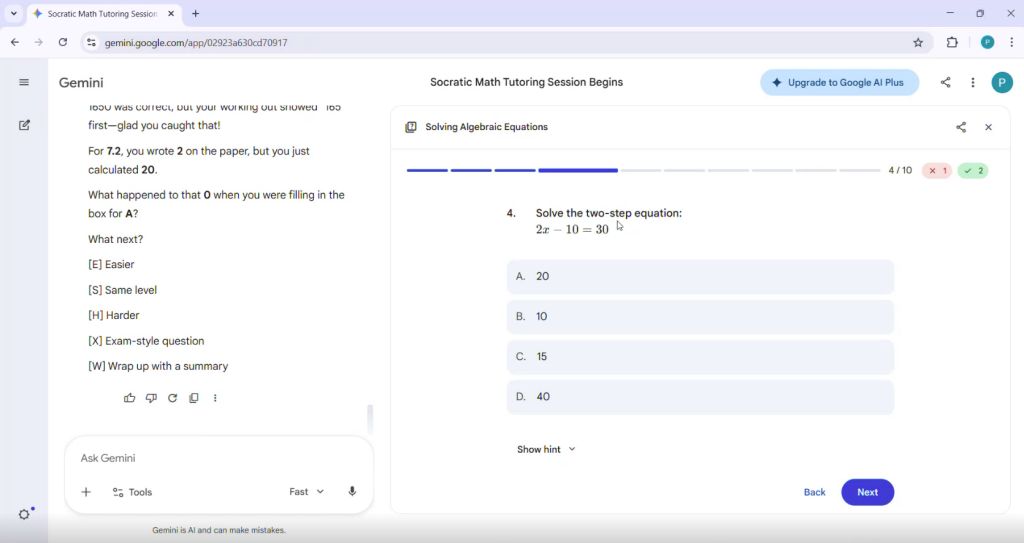
Right now, teenagers are using AI to learn things no timetable would ever offer them. Some are teaching themselves calculus years ahead of their grade by asking AI to walk them through concepts step by step instead of just solving problems for them – one Grade 11 student profiled recently described using AI like a always-available study partner for AP Statistics, testing whether he could actually learn a subject through self-directed conversation rather than passive lessons. Others are going further: building small AI-powered businesses – content tools, tutoring services, design work – while still in high school, using AI as a co-founder that helps with the parts they don’t know yet. None of these students are geniuses with special access. They’re using the same free tools you have. The only difference is how they’re using them.
Here’s how you start, using a simple habit called TACI:
Think first – try before you ask.
Ask AI to guide you, not answer for you (“don’t give me the answer, ask me questions until I get there”).
Check what it tells you against a real source or your own understanding.
Improve your answer, don’t just accept the first one.
The tool isn’t the risky part. Outsourcing your thinking is. Used the second way, AI doesn’t replace your curiosity – it removes the ceiling on it. The question isn’t whether AI will change what’s possible for you. It already has. The question is which version of you shows up to use it.
Get excited.